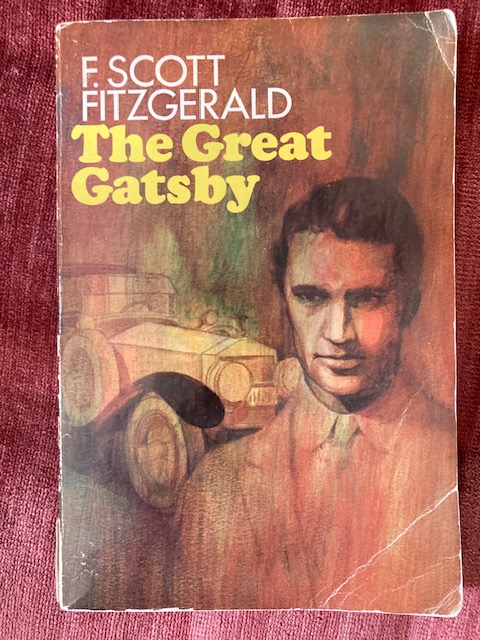
Any list of the 10 best American novels is certain to include The Great Gatsby, F. Scott Fitzgerald’s story of a handsome social climber, who pursues a married woman while suspicions swirl around both his profession and his pedigree. I probably should have read this classic long ago, but only finished it within the last few days. It’s been reviewed over 17,000 times on Amazon alone and probably 17 million times in print media going back to its original publication in 1925. So, what can I add to the comments, criticism, and praise that have been directed toward this book over the last 90+ years? Probably not much, but I’m going to try anyway. Specifically, I’m going to offer my reasons why The Great Gatsby is properly regarded as a classic and then conclude with an observation about one character that may be new.
There can be no doubt that Fitzgerald’s rich, lavish vocabulary helps make The Great Gatsby the great work of literature it is. His character descriptions are profound and insightful. Every feature, every nuance, every habit of a character is described so as to give the reader insight to the character’s physical appearance as well as his or her personality. His description (by way of narrator Nick Carraway) of Tom Buchanan is a case in point.
Her husband (Tom) among various physical accomplishments, had been one of the most powerful ends that ever played football at New Haven — a national figure in a way, one of those men who reach such an acute limited excellence at twenty-one that everything afterward savors of anticlimax…. He had changed since his New Haven years. Now he was a sturdy straw-haired man of thirty with a rather hard mouth and a supercilious manner. Two shining arrogant eyes had established dominance over his face and gave him the appearance of always leaning aggressively forward. Not even the effeminate swank of his riding clothes could hide the enormous power of that body…. It was a body capable of enormous leverage — a cruel body.
Fitzgerald is equally adept at using his extraordinary vocabulary to describe a situation or setting. Consider his description of the lawn outside Tom and Daisy’s home.
The lawn started at the beach and ran toward the front door for a quarter mile, jumping over sun dials and brick walks and burning gardens — finally when it reached the house drifting up the side in bright vines as though from the momentum of its run.
The Great Gatsby also gains some of its greatness from the commentary it provides on the decadence and snobbery that characterized wealthy East Coast Americans living in the 1920s. That decadence can be seen in the reckless, alcohol-driven parties held at Gatsby’s home. It can be seen even more poignantly in Tom Buchanan’s affair with Myrtle Wilson, the wife of a hard-working but dull auto mechanic. As for snobbery, nowhere is it more evident than in Tom’s interrogation of Gatsby over the latter’s background. The interrogation begins with a rather innocent question about why Gatsby calls people “old sport” and ends with a loaded question about “what kind of row are you (Gatsby) trying to cause in my house anyway.” The snobbery reaches a crescendo with Tom and Gatsby going back and forth over who Daisy truly loves, and each man trying to nudge Daisy toward admitting it is he.
And finally, there are the characters themselves. None of them, with the exception of Tom, are completely good or bad. Some of them are hurt and confused, some of them are vaguely aware of the emptiness in their lives, and some of them don’t seem to know what they want. Nick Carraway, the narrator, appears to fall into this last category. At times, he expresses disapproval of the huge parties Gatsby holds, but then other times, he throws himself into these parties with enthusiasm. At the same time, Nick seems genuinely attracted to golfing pro Jordan Baker and pursues her romantically. But then, when she ends up engaged to another man, he doesn’t seem upset. Gatsby himself is an ambiguous figure. On one hand, he seems to love Daisy genuinely (unlike Tom) and to be a generous host to his guests; on the other, he is involved in shady activities with even shadier men (e.g., Meyer Wolfsheim).
This brings me to the one character who, I believe, may carry more significance than he appears to. George Wilson is the mechanic and garage owner whose wife, Myrtle, is having an affair with Tom. Fitzgerald describes him as “a blond, spiritless man, anemic, and faintly handsome.” He’s a pathetic creature who becomes even more pathetic after Myrtle dies. Most literary sources I’ve read argue that Wilson symbolizes America’s working class; someone with neither money nor social standing, and with no hope of ever gaining either. Gatsby, we know, started this way, too, as the son of poor farmers in North Dakota. With the real name of James Gatz, he was a beach bum, who did little more than fish and dig up clams before he met Dan Cody. What he learned from Cody eventually brought him the wealth he had when he met Nick.
So, what is the connection between Wilson and Gatsby? I believe it is this: Wilson represents what Gatsby would have become had he never met Cody. He would have ended up as a 30-year-old beach bum with no money and no social standing. The fact that both Wilson and Gatsby suffer the same fate at the book’s end seems to carry this message: Everything Gatsby did to achieve wealth and status didn’t really change who he was. At the core of his soul, he was just like Wilson — a man with no pedigree, no social standing, and no future. Accordingly, it was fitting that he and Wilson ended up the same way.
You are free to disagree with my points and/or to offer your own thoughts on this great book.
2 responses to “The Great Gatsby: Why It’s a Great Novel”
Not having read this novel — (somewhat embarrassed, since I took a literature degree in college) — I can only comment on the reasoning with which you present your conclusion. Well done! You’ve convinced me… and, furthermore, you make me want to read the book at long last. I’m not sure why I avoided Fitzgerald all these years. Perhaps it’s because so many teachers felt the need to shove him (among others) down out throats.
Thanks for your comment, Jeff. I prefer novels with a lot of action, and I knew there wasn’t a lot of action in Gatsby from summaries I read years ago. That’s probably why I didn’t read it until recently.