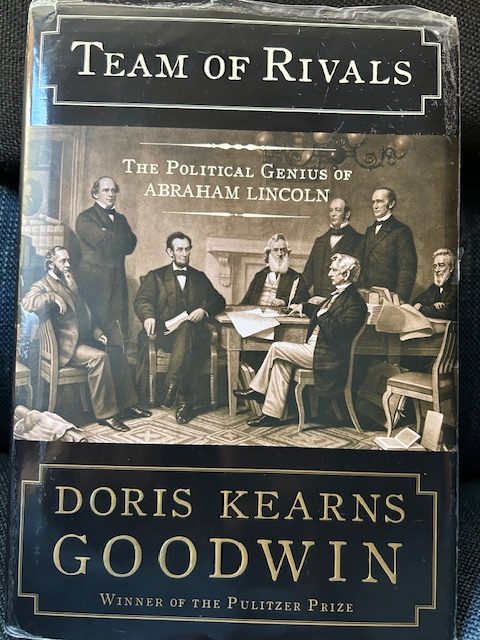
Since elementary school, I’ve probably written close to 100 book reports and book reviews, covering a wide range of genres (though not erotica). My review of Doris Kearns Goodwin’s Team of Rivals (Simon & Schuster, 2005), however, is the first one that will be done in two parts. That’s partly because of the book’s length (880 pages, including Notes) and also because the book itself is divided into two parts. This blog will focus on Part I — “The Rivals.”
In this opening section, Goodwin provides a fairly detailed picture of Lincoln’s early years as well as the early years of the three men who, after opposing him for the presidency, would hold key cabinet posts in his administration.
Future Secretary of State William Henry Seward enjoyed a “privileged childhood” in an affluent family headed by his physician father. Attending a preparatory academy in Goshen New York and later Union College, Seward had an affable, outgoing personality that won him many friends. This personality as much as Seward’s wealth and education, opened the door for a political a career that, with the help of political strategist Thurlow Weed, sent him into the New York legislature and the state’s governorship.
Future Treasury Secretary Salmon P. Chase was the most physically imposing of Lincoln’s three rivals, standing over six feet. Exceptionally religious and fastidious in dress, Chase followed a rigid work schedule both before and after he became Ohio’s governor. But in contrast to Seward, Chase was awkward and uncomfortable in social settings, rarely laughing and avoiding activities such as card playing and attending theater performances, which he considered frivolous. One thing Chase didn’t consider frivolous was molding and shaping his beautiful daughter Kate into a quick-witted young woman who could support his presidential ambitions.
Future Attorney General Edward Bates played a key role in paving the way for Missouri’s statehood and later served as one of 41 delegates who wrote the state’s first constitution. His political career seemed to be on a downward arc until the River and Harbor Convention of 1847. At that event, called to rally opposition to President Polk’s veto of an internal improvements bill, Bates, “to his deep astonishment,” found himself chosen as convention president. Then, toward the end of the gathering, Bates delivered a powerful speech that outlined the danger facing the nation from sectional disputes and the need for statesmanlike concession on both sides. This speech put him into the national spotlight as never before.
Goodwin weaves her narratives about these men into and around her longer narrative about Abraham Lincoln’s early life. She moves from Honest Abe’s humble birth in a Kentucky log cabin to the loss of his mother from “milk sickness” when he was nine and then to his young adult years in New Salem, Illinois. Along this narrative trail, she takes note of the people who shaped Lincoln’s life: Ann Rutledge, his first love; his stepmother, Sarah Lincoln, who encouraged his love of reading; and his father, Thomas, who did not. Goodwin eventually takes us to Springfield, Illinois, where Lincoln embarked on a law practice, as a kind of “experiment.” New relationships blossomed for him in the Illinois state capital, including one with life-long friend Joshua Speed and another with law partner William Herndon.
Though he was not a rival for the presidency in 1860, future Secretary of War Edwin Stanton receives almost as much attention from Goodwin as Seward, Chase, and Bates. Lincoln met Stanton when they were working on the famous “Reaper suit,” otherwise known as McCormick v. Manny. Stanton had little regard for the future president at the time, describing him as a “long-armed ape” who “does not know anything.” His opinion changed once he came to understand Lincoln’s unparalleled leadership abilities. Lincoln’s appointment of Stanton to be his secretary of war demonstrated his singular ability “to transcend personal vendetta, humiliation, or bitterness.”
Goodwin follows Lincoln, Bates, Seward, and Stanton as each man prepared for the 1860 Republican Convention in Chicago, noting the advantages each man enjoyed as well as the obstacles he faced. Kate, for example, was a definite asset for her father’s presidential campaign, but Chase faced a backlash within his own state’s delegation due to a shady deal he worked out with Democratic strongman Sam Medary, enabling him to win a U.S. Senate seat. For his part, Seward had the support of Thurlow Weed, as he had in the past. However, he faced opposition from former Know-Nothings, who, years earlier, had opposed Seward’s support for parochial schools when he was governor of New York. In the end, the convention may have been more a defeat of Seward rather than a victory for Lincoln.
It is not hard to see why Team of Rivals has received so many accolades from historians and book critics. Goodwin has marshalled a massive volume of primary source material to support her narrative of Lincoln and his political opponents-turned-cabinet members. Contemporary newspaper reports, published speeches, diaries, and memoirs written by key people in Lincoln’s life provide a solid foundation for her observations and arguments. Indeed, the Notes at the end of the book cover no fewer than 120 pages. Even more impressive is the smooth, often clever way the author blends her own words with those of an individual she is quoting. For example:
On p. 224: From the time he had first spoken out against the extension of slavery into the territories…Lincoln had insisted that while the spread of slavery must be “fairly headed off,” he had no wish “to interfere with slavery” where it already existed.
On p. 307: Lincoln’s spirits began to revive somewhat as he witnessed the friendly crowds lined up all along the way, buoyed by “the cheers, the cannon, and the general intensity of the welcome.”
There are a small number of grammatical errors in the Team of Rivals copy I read. These weren’t too big of a problem. A mistake that does stand out occurs on p. 242 when Goodwin identifies Indiana Governor Henry Lane as being from Pennsylvania. Given the large number of people of have read Goodwin’s book, I would expect this error had already been pointed out to her and corrected.
In my next blog, I’ll review the second half of Team of Rivals.