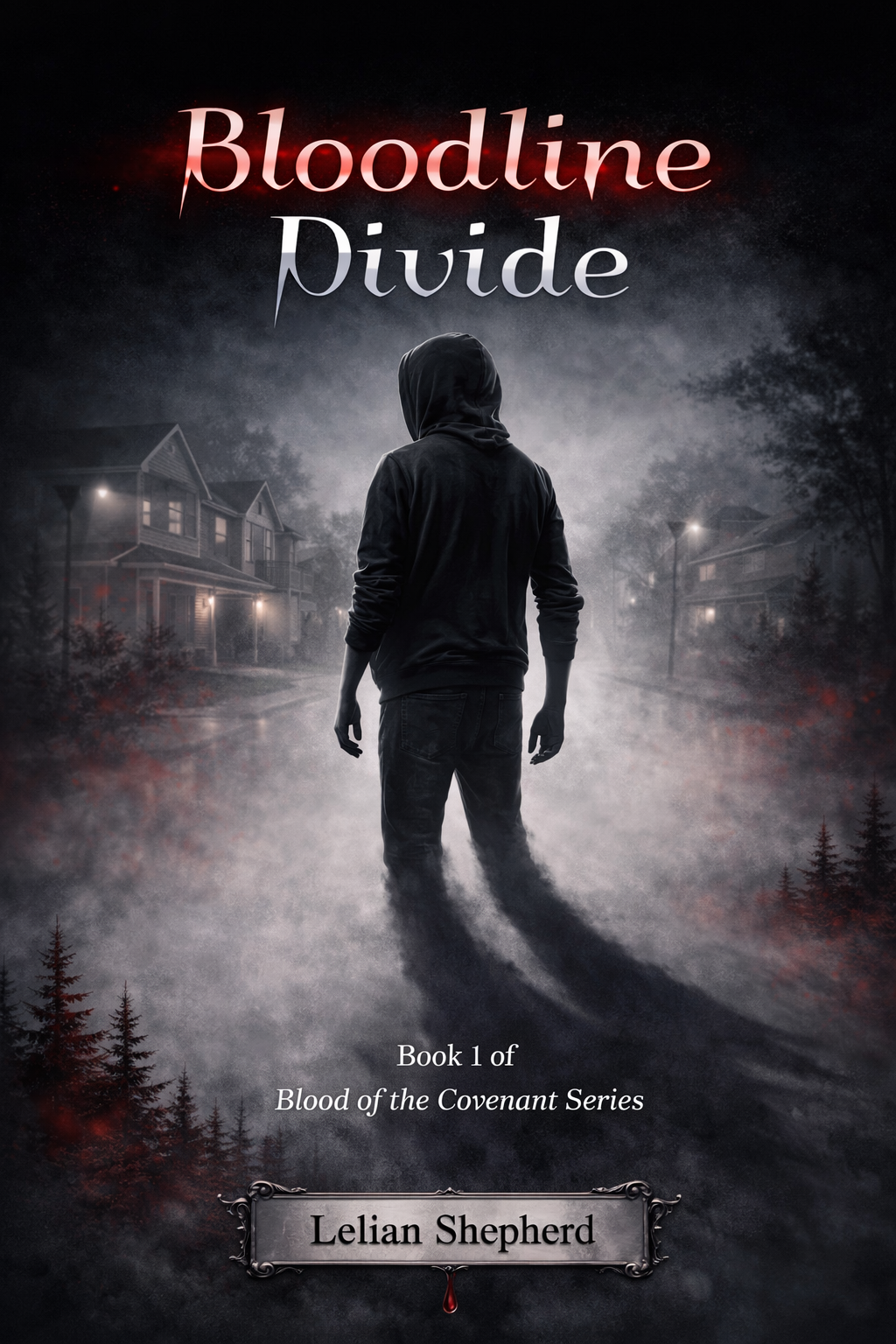
A few weeks ago, I featured fellow Van Velzer author Kathryn Haueisen on this blog. For this post, I’m turning my “pen” over to Lelian Shepherd, whose novel Bloodline Divide will soon be published by Van Velzer. Many vampires have stalked through the pages of novels since Bram Stoker’s Dracula came out in 1897 – but I doubt if any of these vampires have been like Kyle. From here on, I’ll let Lelian tell his story.
Scene: While scrolling Facebook in the mid-to-late 2010s to kill time, you come across a Tumblr post cross-posted to it. Curious, you click on the shared image to enlarge it. It reads:
“What if a person became a vampire, but didn’t realize they had become a vampire?”
And that, friends, is how Bloodline Divide started. I found the whole premise delightful and hilarious, and that “what if” started me on the long, winding pathway towards publication.
The first step in the creation of my novel was answering questions beneath that larger one: How would they explain away the thirst for blood? How would they justify new strengths and weaknesses and sensitivities? What would those strengths/weakness/sensitivities be? What would it take for them to figure out they were a vampire? How would the people around them be clued into and react to this change? Were there any other supernatural creatures besides vampires? Were vampires publicly known or thought to be just stories? With each question answered, another was engendered.
Those answers were seeds that germinated into the scenes of the first draft. These scenes were almost entirely character interactions that taught me their voices, motivations, relationships. There was no plot outside of the original question. The first draft was characters talking, revealing things to each other and to me about themselves and the world. I was filling in each tile of a blank puzzle individually without really knowing how they fit or what the final picture would eventually look like. Most of the puzzle’s picture was still missing by the time the first draft was done, but the border was complete and the interior at least had a pencil sketch.
While each draft’s refinement filled in more of the puzzle’s picture, what provided the most insight came not from the novel itself, but all the writing done adjacent to it. Bloodline Divide’s main story was written purely on my laptop. However, I have probably hundreds of hand-written pages that detail the story’s events from everyone but the main character’s—Kyle’s—perspective. Since the novel is written in first person, the reader is treated to a myopic view of events filtered through Kyle’s thoughts, feelings, and worldview. This also means the actions and behaviors of Kyle himself as perceived by him. I learned more about him by asking his mother, his best friend, and his sister about him than by sitting with Kyle himself. As an example, I didn’t know what his career aspirations were and why his faith was so strong until his sister, Tana, told me.
It wasn’t just Kyle who was fleshed out by this process, though. I didn’t know how his mother, Hope, fit in his story until she had an existential crisis about her son’s new vampiric nature and her history as a vampire hunter. I didn’t know why the parish priest, Father Andrew, would know as much about vampires as he did until Hope mentioned working with him during her vampire hunting days. Each new revelation and detail was pulled not from Kyle interacting with his friends, family, and mentor but by them interacting with each other.
Writing a first-person perspective novel is an exercise in solipsism—the story does not exist outside the perception the narrator. However, that is not to say that the world of the novel is not also inhabited by the other characters, that they are not the protagonists of their own stories within the story. Writing their perspectives, intertwined with but apart from the novel’s plot, helped create characters and an environment that felt more authentic and nuanced. What Kyle couldn’t or wouldn’t see, they could; what he couldn’t or didn’t know, they did. He was a much flatter and frustrating character before I asked the other people in his life about him and incorporated what I learned.
Moral of the story: listen to your supporting characters if your main character is being stubborn and silent; the characters around them have more to say than you might think.
More About Lelian Shepherd
I was the kid who got in trouble for reading when I should have been paying attention in class and now hope to create stories that get others in trouble for the same reason. Levering a potent mixture of ‘delulu is the solulu’ Leonine energy, unmedicated ADHD, and actual formal training (I do have an MFA in Creative Writing from the New School), I have turned my “voracious and advanced reader” energy from my childhood into “what do you mean you wrote a story that broke Google Doc’s character limit” in the hope that my brainrot will prove both entertaining and relatable. I live in Florida, dodging hurricanes, Florida Man, and terrible Miami motorists while pursuing my passion for both writing and forensics.