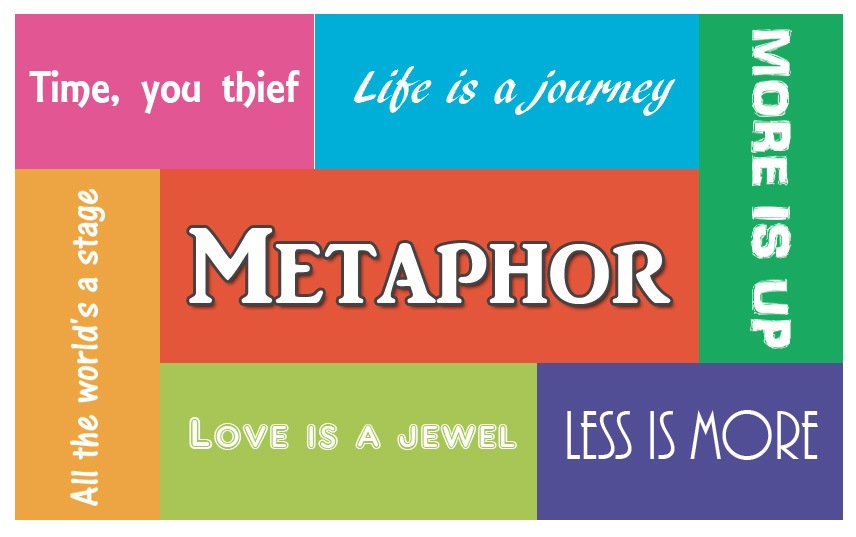
The popular musical The Fantasticks revolves around a boy meets girl-next- door romance that receives some subtle encouragement from the respective fathers. In one particular song, the boy, Matt, expresses his love for the girl Lucinda, in a series of vivid metaphors. Imagining himself on a desert, he describes her as “cool clear water” for his parched mouth. Switching to a world of snow and ice, he sees Lucinda as a “fire alive with heat.” Then, in a stirring conclusion, Matt exalts her as “sunlight,” “moonlight,” “mountains,” and “Polaris, the one trustworthy star.” Not surprisingly, the title of the song is “Metaphor,” and besides dramatizing Matt’s love for Lucinda, it demonstrates just how powerful that figure of speech is.
The technical definition of a metaphor is “a figure of speech in which a word or phrase is applied to an object or action to which it is not literally applicable.” True enough, but this definition doesn’t express just how effective and impactful metaphors can be. Metaphors don’t pull their punches, They are direct, no-nonsense figures of speech that tie two unlikely things together in a way that grabs readers’ attention. Whereas a simile shows how one thing is similar to another, usually using the words “like” or “as,” a metaphor goes a step further and claims two things that seem different are actually identical.
Metaphors often make a poem or speech more memorable. Consider these examples:
John F. Kennedy describing our country’s determination to reach the moon: “America has tossed its cap over the wall of space.”
Martin Luther King stressing his leadership in the Civil Rights Movement: “I’ve been to the mountaintop …. and I’ve seen the Promised Land.”
William Shakespeare in Macbeth: “Life’s but a walking shadow, a poor player.”
Sylvia Plath in “Two Lovers and a Beachcomber by the Real Sea”: “Cold and final, the imagination shuts down its fabled summer house.”
In these stressful times of angry politics, Internet-fostered extremism, and diminished privacy, a warning must go to anyone who considers using metaphors that will be seen or heard by the public. Don’t use metaphors if there is any chance they could be taken literally. Or if you do use them, be prepared for the consequences.
During the January 6 attack on the Capitol, some of the attackers called for Vice President Mike Pence to be “hanged.” Did these people really want to put a noose around Pence’s neck? Probably not. But those words made the attack on the Capitol appear even more violent and vicious than it already was. The attackers who used that metaphor may have regretted it when they came to trial.
A few days before a would-be assassin wounded former President Donald Trump at a political rally, President Biden said “It’s time to put Trump in a bull’s eye.” Did Biden wish the former President to be shot? No, but some of his political foes suggested his “bull’s eye” statement may have inspired the assassination attempt.
Trump himself has thrown out some volatile metaphors, including the accusation that Biden is “running a Gestapo administration.” Not even Trump can believe such an outlandish claim, but his Democratic foes can be expected to say it’s an example of his out-of-control extremism.
There are actually several types of metaphor, and I’ll explore some of those in my next posting. In the meantime, clad yourself in the armor of civility and clasp the shield of knowledge as the 2024 Presidential campaign begins.