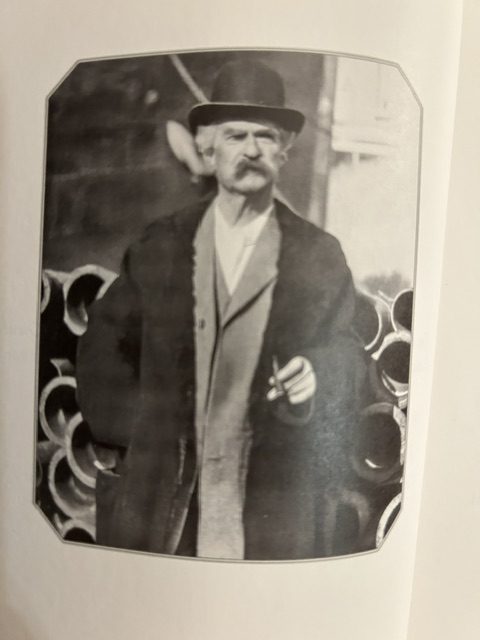
Chernow labels the last three sections of his Mark Twain biography as “Rapids,” “Whirlpool,” and “Shipwreck”; metaphors that capture the turmoil and tragedy that ran through Twain’s life from middle age to his death at 74 in 1910. Yet, if one thing stands out in the last half of this book, it’s Twain’s creative genius which did not diminish even as his health began to decline.
That creative genius led to the writing of The Adventures of Huckleberry Finn, often regarded as one of the greatest works in Western literature. Chernow notes that Tom Blankenship, an actual ragamuffin kid from Twain’s boyhood, provided the inspiration for Huck Finn. At the same time, Twain blended several black men into the character of escaped slave Jim, including master storyteller Uncle Daniel and the wise butler George Griffin, who served the Clemens household in Hartford. Chernow grants that the pairing of 14-year-old white boy Huck with Jim, an enslaved man of middle age, seems “incongruous.” But he explains that Twain saw them bound together by a “community of misfortune.” In Twain’s own words, “Huck is the child of neglect and acquainted with cold, hunger, privation, humiliation, and the unearned aversion of the upper crust of the community.” As such, he is the perfect partner for a desperate escaped slave. And it is the Mississippi River, “existing beyond the bounds of society,” that offers them “a wild taste of freedom.”
Twin’s creative genius found expression in other significant works toward the end of the 19th Century, including Joan of Arc and What is Man? Many of these compositions expressed his growing disdain for traditional western views of God as well as his dismay over America’s effort to become a colonial power on par with European nations. But Chernow tell us that even as Twain’s creative genius sprang forward, his personal life was buffeted by serious financial problems and stresses within his family.
His investment in the Paige printer probably represents Twain’s biggest financial blunder. This device was supposed to revolutionize the printing of newspapers but glitches in its operating parts made it a failure. Twain also lost money when he tried to become a publisher as well as an author. His Webster & Company got off to a good start when it published Ulysses S. Grant’s Memoirs. But it sank in part because it took on the enormously expensive task of publishing The Library of American Literature.
Twain’s financial woes did have one unintended benefit; they prompted him to undertake a worldwide lecture tour for the purpose of earning money to pay off the enormous debt he had accumulated. This tour to cities in India, Australia, Ceylon, South Africa and other faraway countries added to his renown abroad even as it made him a much-revered celebrity in the U.S. He was nearing the end of that tour when tragedy struck – his oldest daughter, Susy, died of meningitis. Thereafter, Chernow tells us, Twain became vulnerable to bouts of depression as well as increasingly intense physical ailments.
As he moved toward his 70s, Twain faced more family tragedy with the death of his wife Livy in 1904 and the intense epilepsy of his youngest daughter Jean. According to Chernow, Twain compensated for the stress generated by these calamities in two ways First, by forming affectionate (though probably chaste) relationships with pre-adolescent girls. Twain even organized the girls into clubs and enticed them to visit him at his home. When they returned to their own homes, Twain sent them flirtatious letters telling how much he missed them. Second, Twain gave Isabel Lyon a wide-range of household duties that went far beyond her regular job as secretary. Lyon often accompanied Twain to social events and even took charge of managing some of his financial affairs. Eventually, Twain discharged her partly because she engaged in some petty thefts and conspiracies behind his back with her husband Ralph Ashcroft.
Twain battled a number of physical ailments throughout his life, including bronchitis and gout, but it was complications from angina pectoris that brought his life to an end on April 21, 1910. Chernow argues that Twain died a bitter and depressed man, having lost his daughter Jean the year before when she suffered a seizure while bathing, which led to a heart attack. But to Chernow and just about everyone else, Twain’s fame has justifiably stood the test of time. In Chernow’s words, “Twain had not only moved people to laughter and tears with his books, but had challenged them with unorthodox views …. He had dared to state things that others only thought.”
I highly recommend Chernow’s Mark Twain. He perhaps provides more detail on the author’s life than some readers would prefer, but all his observations are backed up by solid research built around primary sources including diaries, contemporary newspapers, letters, autobiographical notes, and Twain’s own notebook.