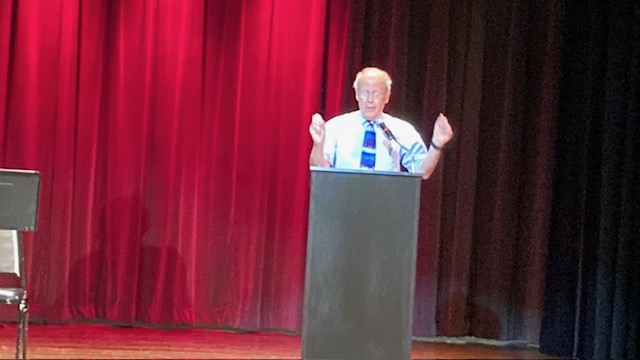
A couple of weeks ago, I had the opportunity to present a session on “Using the Written Word to Improve Society” for the McConnell Arts Center’s Lifelong Learning Institute. As part of my presentation, I highlighted six guidelines on good writing that were based on my experiences as an editor for the Ohio Department of Education and am English instructor at Columbus State Community College. I will present the first four guidelines in this blog and the last two (which require more elaboration) in my first October post.
- AVOID ABSOLUTE WORDS AND PHRASES. Always, never, impossible, everyone, nobody, it must be this way, it can’t be any other way, there are no exceptions. These words paint you into a corner, and give you no flexibility. They can be especially risky if someone is opposing your idea or argument. If you say, “My idea is certain to work; there is no way it can fail,” your opponent only has to find one example to the contrary to torpedo your plan
- CONSIDER THE AUDIENCE FOR YOUR COMPOSITION. Make an effort to determine the people who are most likely to read your what you’ve written. How well do they know you? If you are unfamiliar to them, you may have to spend some time establishing your credibility, making it clear that you are both knowledgeable and trustworthy. If your potential readers do know you, how do they feel about you? If they like you, you have a head start on winning them over. If they are neutral or have negative feelings toward you, it may be a good idea to find some common ground with them before introducing your main point
- CLARIFY WORDS, SUCH AS ACRONYMS, THAT MAY BE UNFAMILIAR TO YOUR READERS. If you had worked for the Ohio Department of Education in the 1980s and 90s, you might have encountered the following acronyms: SAT, SERRC, and ORCLISH. Some people, especially those with high school-age children, would have known that SAT stood for Scholastic Aptitude Test. But the other two would likely cause uncertainty and bewilderment. That’s why before using an acronym, its full name should be used with the acronym following in parentheses: Special Education Regional Resource Center (SERRC); Ohio Resource Center for Low Incidence and Severely Handicapped (ORCLISH). It’s also important to realize that words can carry different meanings for different people. That’s especially true of abstract nouns, such as community, progress, success, victory, liberty, democracy. During the years leading up to the Civil War, both Southern and Northern politicians would speak of their commitment to preserving “liberty.” But no less a man that Abraham Lincoln realized the word “liberty” meant something different in the South than it did in the North: “We all declare for liberty but in using the same word we do not all mean the same thing. With some, liberty many mean for each man to do as he pleases with himself and the product of his labor, while with others the same word means for some men to do as they please with other men and the product of other men’s labor. Here are two different and incompatible things called by the same name – liberty.” Like Lincoln, writers should be sure the words they use will mean the same thing to their readers as it does to them.
- HAVE YOUR COMPOSITION REVIEWED BY SOMONE WHOSE JUDGMENT YOU TRUST. No matter how confident you are about the clarity of your writing and the logic supporting it, have someone you trust look it over. Even the best writers can overlook errors in grammar or sentence structure that could potentially damage their credibility. I always have my wife review the most-important essays and stories I write. More often than not, she finds small but potentially harmful errors that I missed in my own reviews.
In the next post, we’ll examine the two final guidelines that require some elaboration, specifically, using specific rather than general words, and being alert to how the intensity and connotation of words can affect their impact on readers.